To return to Art History home page, click on this link:
October: 'The Elephant & The Dove' : Frances & Rob!
We may all now better appreciate how intertwined were both the creative and love lives of Frida and Diego.
From their first meeting in Mexico City, Frida the school girl, Diego the budding muralista, then their controversial sojourn through the US ..


… the ‘Califia’ mural affair (Helen Wills Moody!) in SF; the Ford murals edginess in Detroit; the last straw ‘Master of Universe’ with Lenin at Rockefeller NY)…
To Frida’s emergence from under Diego’s wing as a primordial, raw artist, 'exposing all' through her Mexican folk and personal pain influences …


… it may be difficult to consider either again as truly independent artists.
The tension both in their relationship and revengeful affairs, stoked the fires of artistic output, driving Frida to outshine Diego’s almost underrated achievements in art history folklore.
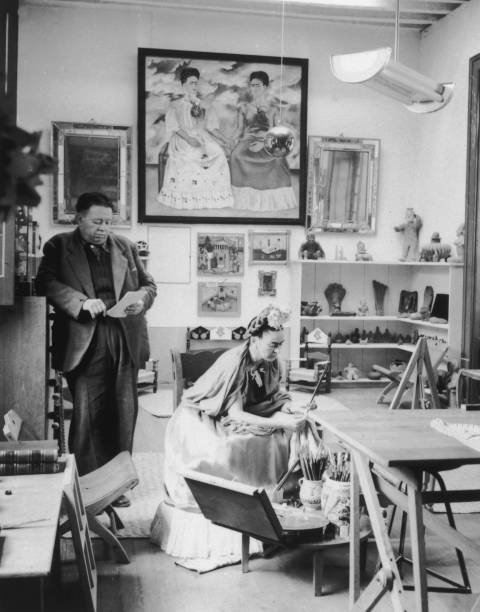

Their works of art speak for themselves, both conceptually and in their detailed content and deeply reflect the love which tormented, but never died.


Frida said that despite all, it was much better to be with Diego than without him and that ... ...‘art itself was not enough’
September: ‘The Life & Art of John Piper : Speaker Lizzy Rowe
It is impossible to believe that JP could have achieved any more breadth of experience and achievement across the spectrum of artistic media …….. from his early interest in churches, his more ‘provnciall’ art (eg ‘Coast’ in Rye, E. Sussex) and his formative painting and mixed media, influenced by the likes of Picasso and Braque (eg String Solo) …


… to his experimentation in abstract expression (eg Forms in Dark Blue) comparable to Mondrian, and his first foray into neo-romantic, contrasting dark skies, just-pre-war (eg Regency Square from West Pier Brighton with John Bentjeman)
War time inspired another demonstration of ‘artistic’ skills with his Windsor Castle watercolour royal commissions in famously (!) stormy weather, his 1940 paintings of the bombarded Coventry Cathedral, followed by …


….. his stunning stain glass Bapistery window as part of the cathedral reconstruction (with 198 pieces of glass!).
In fact Piper’s collaboration with John Rentyiens on stained glass is a lasting tribute to his amazing versatility and collaboration across ‘art’ forms, including with Geoffrey Estop in ceramics, Benjamin Brittan on stage sets, John Betjeman across -the- board and with the Pinton Freres tapestry specialists for his joyful masterpiece in Chichester cathedral.


Not forgetting, of course, JP’s (and his partner’s !) wonderful stained glass windows in local churches like Bledlow Ridge and St Bart’s Nettlebed … go see them up-close!
August 2025: Achilles Lauge
Occasionally you get surprised in life, even at Art History meetings … and last Friday was a classic example (really sorry if you missed this!!).
We probably expected Andrew’s presentation on the lesser known Achilles Lauge to be about a few well lit paintings under the Aude region’s sunlight in southern France.


But what a story! … how Achille left his native Cailhau near Carcassone to study at the Ecole des Beaux Arts in Paris …
…. how he then rejected the cool, bohemian art scene in Paris to return to his beloved Cailhau to hone his own interpretation of the neo-impressionist ‘divisionism’ techniques ….


… (Note: this was not just pointillism but, as Andrew helpfully explained, as pioneered by Seurat and others the optical blending of colours via the viewers eye from the artists build-up of a whole, subtle variety of different dots or patches) ….
… how he left his special mark on turn-of-the-century experimentation by illuminating this (literally!) through, not just landscapes like many others, but also floral and portraiture works …

… and, back in Cailhau, less influenced by his pressing peers in Paris, being confident to plot his own course, bravely doing own thing, or, as Andrew concluded …
… ‘living life doing what he loved, in a place he loved, with people he loved'
A very, very big thank you to Andrew for a great presentation, surprising us with breadth and depth of Achille’s achievements, as witnessed down below by just a few examples.
And check-out the upcoming exhibition (Sept-Feb), ‘Radical Harmony’, at the National Gallery around that same genre of art history.
July 2025: Kenwood House Visit
37 of us started with a very professional guided tour of this beautiful house former home of William Murray, Earl of Mansfield and more latterly Lord Iveagh of the Guinness family.
Appropriately for us, emphasis of the tour was on art which was totally unavoidable (!) as the rooms were full, floor to ceiling with interesting paintings (and the Robert Adam interior design was equally impressive, with beautiful painted ceiling library and the bust of Zeus-Ammon, a 2000 year old copy of a 3000 year old original, acquired by Mansfield in the early 18C.).
As usual, by way of offering up just a few highlights, the ‘connections’(we love them, don’t we?), remaining questions and unusual details made it a lot of fun, as art should always be!
For example:
Vermeer’s charming ‘Guitar Player’ on its original 1672 ’stretcher’/canvas .. a friend of Rob’s visited Kenwood to view the painting in 1974 and the very next day the painting was stolen after a break-in ..why would our Kenwood guide not 'officially answer' our questions on this theft?
Rembrandt’s late-life self portrait was delicate in detail but , in contrast, the ‘master’ is presenting himself as self assured. What exactly did the two circles in the painting represent?


Peter van Broecke’s portrait, a perfect example of how Frans Hals led the way in projecting the real character of sitters in the mid-17C, through their warmth and informal, more relaxed qualities (and that hand!)
Despite its different subject matter, ’Two Girls Dressing a Kitten by Candlelight’ shouted out as a 'Joseph Wright' … remember Rob showing his ‘Experiment on a Bird in the Air Pump’ in his ‘Art is History’ presentation, equally as ‘dark’ in subject matter as the ‘Kitten Dressing’! (and both heavily drenched with the Caravaggio ‘chiaroscuro’ light-contrasting technique.
What about the connections and totally different ‘takes' on the beautiful Dido Belle?? ... the ex-slave, adopted by the Earl of Mansfield, one painted in 1778 (with Mansfield's niece) yet with a highly modern finger- to-face expression, the other, full frontal, painted relatively recently, almost in a modern heroine ‘perspective’, by Mikela Henry-Lowe.


Even more ‘historic’ .. the full width painting of London Bridge, resplendent with houses, painted by De Jongh in 1627 … how would we know if not for ‘art’?
Then onto the luxuriant Singer Sargent ‘Heiress’ exhibition … what a technique JSS crafted, in terms of his representation of silks, chiffon and the delicate highlight touches for jewellery but equally impressive were his charcoal pieces!


Interesting ‘connection’ here? how the pose in Sargant's Nancy Astor was derived from a George Romney portrait of Lady Emma Hamilton (i.e. Emma Hart,’actress'’and future wife of Nelson) whose several paintings we had seen earlier in the day (Romney, who many of us hardly knew, had painted ‘Emma’ over 80 times, infatuated or what?!).
Great fun, cool ‘connections', a fascinating ‘art-full’ visit!
June 2025: 'German Expressionism & the Blue Rider Group'
This ‘thank you’ letter to Matt for a fascinating presentation reflects our genuine enjoyment of the presentation:
'Everyone really enjoyed it … their positive take-out seemed to focus on giving great insights not just into the German Expressionist movement but, through Kandinsky specifically, into the evolution of abstractionism in art’.
So our journey with Matt: took us through Kandinsky’s transit through post-impression (influenced by Cezanne and the like) to the more ‘expressionist’ style of the early 19th Century avant-garde era where artists strove to reflect their interior selves (emotion, mental, thought, psyche) through their work rather than be limited just by ‘realism’ (or even the ‘motif’ as Matt said!)


Breaking away with Gabrielle Munter, Franz Marc, Jawlensky and others to form the Blue Rider group in 1911, and influenced by movements like (eg) spiritual Theosophy, visual characterisation of thoughts (’thought forms’) and music, Kandinsky in particular evolved his style from general expressionism into one of the first real demonstrations of abstract (and semi-abstract) art.


Although its momentum was interrupted by the repatriation of Kandinsky to Russia, the death of Franz Marc in the FWWar, and the atrocious Nazi Degenerate Art exhibition in 1937, the emergence of abstract art was here to stay, heavily influenced by Kandinsky and others through early expressionism.
May 2025: ‘Art is History, History is Art’ : Rob Holdaway
The purpose of Rob’s presentation was ‘to help us share, appreciate and remind ourselves of the role of art in shaping our view of history and its accompanying stories’.
This presentation showed how art recorded, reflected and ‘remembered’ the history of our lives, events and achievements through fact, dramatisation or even fiction.
It was a broad sweep across a number of themes including ‘art’ from time immemorial, the shaping of our minds through religious representation …..


….. the events and lives of our rulers, how ‘we were’ (or lived) in former times .....


…. the milestones of discovery and invention, the telling of the horros of war and racism ......


....... the hero artists as 'history makers' themselves and finally, and incredibly ....

....... art in the service of legal evidence and land entitlement.
April 2025: Alfred WAllis
Alfred Wallis .. Wondrous Cornishman : Ray Barnett
A really big ‘thank-you’ to Ray for his intriguing presentation about unsung Cornishman Alfred Wallis.

And what an inspiring, yet sad, story …born into relative poverty in St. Ives and off to sea at an early age, Alfred only really took up painting aged 67 after Susan his wife died.
Working with rudimentary low cost materials of (eg) ships paint and cardboard surfaces, the charm of his work was in its pure simplicity of line, colour and flat form relatively minimal perspective (some term it ‘naive’ but ‘visceral and instinctive’ may be more accurate).
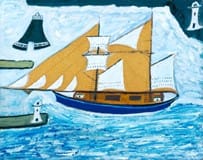
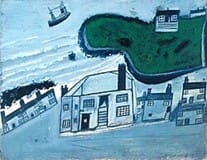
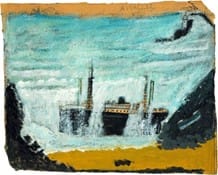
But the magic ingredient of his local Cornish, coastal sea-ship-scapes was the ‘Alfred DNA’ from whence it came …
…. totally reflecting his feeling and perception from a lifetime soaked (literally) in ‘St. Ives’ (and earlier at sea from memory) and how that translated into his narrow colour palette and his own, very personal impressions of the world of ‘ships, lighthouses, ports and quaysides’.
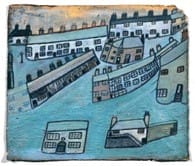
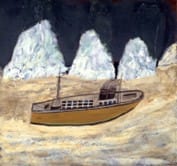
As Barbara Hepworth said (wife of Ben Nicholson who helped discover Alfred): ‘We certainly don’t know how much we all learned from Alfred … and took of him’ (and may be there’s more than meets the eye in that comment!)
The one and only Alfred Wallis!
March 2025: Delightful Degas : Janet Erskine
The name Degas is a familiar one, but it was fascinating to hear Janet skilfully trace his artistic development from copyist, portraitist, history painter, photographer, painter of horses and ballet dancer to remarkable figurative sculptor - quite the CV, you would agree?!
It was interesting to hear from Janet how Degas’s his art progressed as witnessed by a few images below.
First the man himself! …. and his first portrait, ‘the Bellilli Family (1858) to which he was related ….


Followed by his first, early venture into ‘history’ painting …’Young Spartans Exercising’ (1860)

Degas also had a life-long love of studying and painting horses, becoming famous for this genre .. as well, of course, his famous ballet masterpieces …


Not to mention, finally his intimate sense and feeling for sculpting the human form, best demonstrated by ‘Little Dancer’ (1880) .....

.. big thanks to Janet, ‘Delightful Degas’ for sure!
February 2025 : The Art of Partying: Alice Foster
We would like to offer a big ‘thank you’ to guest speaker Alice Foster for such an enlightening presentation ….

… and what a fascinating theme which served as the ‘vehicle’ to explore the work of a whole spectrum of artists across the ages, a number of which were new to us!
And, by so doing, underlining the role of art to give insights into the range of social habits and lifestyles across cultures, in many cases long before the advent of photography to bear witness!
We travelled rom Giotto, Bruegel and Velasquez to the Glasgow Boys (John Lavery) and Paul Cadmus ('Sailors & Floosies', what a title!) …
…. right through the pre-Raphaelites (J.E. Millais’s poetry inspired Lorenzo & Isabella) and its more modern take, ‘Dinner Party’ by Sam Walsh) and then ... on to the wonderful ‘Dance of Life' by Paula Rego and then … … Renato Guttuso’s ‘Boogie Woogie’ with its social commentary post-war ‘release’ and fashion trends (including ‘blue jeans’!), not to mention Judy Chica
December 2024: Art in Photography: Brian Fowler
A big ‘thank you’ to Brian for his most thought-provoking presentation last Friday on ‘Art in Photography’.
Setting the scene, Brian encouraged us to start thinking of art in all its forms (eg painting, creative writing, music) as a ‘form of expression, intending to invite and stimulate us to ‘engage’ with it …
…..and no less than in the case of photography, the parallel example between art and photography being … ‘With The Beatles’ album cover and Cezanne’s famous ‘Grandes Baigneuses’! …
…. i.e. both with stripped away simplicity, figures in the foreground of focal plain for direct ‘engagement’ and a very limited palette …
An equally surprising example of artistic expression, equal to painting and photography, was Dickens’s incredible character portrayals, so skilfully expressed to captivate the reader (in contrast to CD’s dry parliamentary reports!)
In ‘directing’ art IN photography, ‘less’ can sometimes be more in engaging the viewer .. as seen, for example, in the skills of contemporary black and white landscape photographers … limited, understated palettes to appeal to, and truly engage with, their environmentalist target audience….
… in contrast to the more instinctive shock and awe, but no less ‘artful’ works of live action photographers like Phan Thi Kim Phuc, inviting us to (even challenging us!) to engage when it’s not at all appealing. Not to mention the possible good fortune (or instinctive reactions!) of artistic photographers ‘in the moment’, like the subtle overhead bird shadow below and, at the other end of the spectrum, the ‘post-manipulation’ skills of modernistic, urban photographers who combine multiple images and digitally, very subtly massage key elements .
Following Brian’s enlightening presentation may be we will remember in future to be equally mindful of the creative role of ‘art IN photography’ as much as we are with the great painters we revere through history.
October 2024: British Artists .. First Half 20th Century … Guest Speaker Keith Appleby
It was fascinating to hear from Keith about the influences on these artists from either different stylistic art trends in other countries or from societal changes of the time, such as politics or war.
The peaceful pre-First World War scenes from the Camden Group’s Charles Ginner (St Just, Cornwall) and Harold Gillman (Canal Bridge …much like Van Gogh’s in Arles!) for example …
….. were in stark contrast to the parallel output of artists like Percy Wyndham-Lewis (The Dancers) and Christopher Nevison (La Mitrailleuse, below) heavily influenced respectively by Picasso’s (and others’) Cubism and Marinetti’s Futurism ....
…. but nothing like the contrast with the mood set by the First World War itself, so starkly reflected by (a) official war artists such as Paul Nash (eg ‘We Are Making a New World' 1918) and (b) the adverse reaction and protest against the war by artists like Mark Gertier (eg. The Merry-Go-Round, above)
Things settled a little between the wars with softer, more ‘colourist’ output from (eg) Matthew Smith and the more satirical output from Cookham’s Stanley Spencer (‘Dustman & Lovers’) but the ‘edge’ was never far away with Nash’s Second World War works and Graham Sutherlands abstract works, including his 'Thorn Tree' and crucifixion studies, not to mention his controversially realistic take on Winston Churchill.
But there was still hope around (even before the 'soon to be seen’ Andy Warhol!) … contrast the wonderful ’Trendine in Sun’ (David Bomberg) from Cornwall with Charles Ginner’s 1913 'St Just’, not to mention Ivon Hitchens’ ‘abstraction’ (rather than ‘abstract’!) landscape works.
And FINALLY (above)as one member rightly asked, ‘what about the women artists? … and there are many wonderful examples in this period including Vanessa Bell and work at her Charleston House and Dora Carrington (eg. ‘A Spirit Inside’ which inspired the Compton Verney exhibition of the same name that we viewed on our visit in July)
September 2024: ‘Off The Record’ (an history of record album cover design art’) … Guest Speaker: Rupert Dickens
Well what an interesting ‘Art History’ presentation our guest speaker Rupert Dickens treated us to, showing us …..
How ‘pop'ular artists like Andy Warhol challenged traditional design and could make a huge difference in the success of record albums (e.g. 'The Velvet Underground & Nico’, signed by Warhol… peel that banana!) ….
How renowned artists themselves were attracted to album design (eg. Salv’ Dali with his surrealistic ‘Lonesome Echo’ cover and Man Ray’s unpublished ‘Exile on Main Street’) and how artists were subtle influencers of album designers (eg Magritte’s apple and surrealistic skies)…
How skilful artists like Peter Blake helped collapse the boundaries between high art and popular culture (witness 'Sgt Peppers Lonely’ with its 58 famous characters on the cover painted in colour, by hand!…)
How even album cover ‘art/design’ can command relative high valuations (note Ringo Starr’s personal copy No: 0000001 of The White Album sold for $790,000 in 2015) …
How album design became a professional art speciality in its own right with ‘agencies’ like Hipgnosis, famous for album covers such as ‘Wish You Were Here’ (remember that fire stunt story?!) and ‘Elegy’ by The Nice’ (those fifty red footballs receding into the Sahara Desert), not to mention
… ‘Dark Side of The Moon’ which was symbolic of the world of abstract art where ‘without any meaning to the art, it can give even more meaning’ (think about it!).
August 2024: ‘Victory is not an Option’: Maurizio Cattelan
Grateful thanks once again to Gwyneth for her fascinating (!) and totally different presentation on Maurizio Cattelan’s jolting (‘Victory is not an Option’) exhibition at Blenheim Palace in 2019. Here’s an extract from our ’thank you’ e mail to Gwyneth: …
…...'It was great fun watching and listening to peoples’ reactions …… should I laugh? … should I be shocked? … ‘is this art?’ (well, what is?). But …. you rounded off so nicely by showing the Sistine chapel ‘shed’ and everyone 'oohed and aahed’, thinking ‘may be there’s something to this crazy man after all’? …. (and then, ….. they saw the toilet!)
One couldn’t imagine a more contrasting backdrop than the historical, formal, patriotic Blenheim palace to exhibit the challenging (surrealistic even!) but highly creative sculptures and ‘installations’ from the hand of the prankster of the art world, Italian Maurizio Cattelan. The range of creative output couldn’t help but amaze! … from the Union Jack draped palace courtyard ('should I really step on this?’); hanging models of Maurizio himself (gallows humour?) and the sacrilege of a (wonderfully!) sculpted Pope John Paul II, to ……. a beautifully crafted 18 carat golden toilet weighing 55 pounds, parodying the excesses of the art market and stolen within days for its mineral wealth; and the mind blowing, hand painted mini-replica of the sistine chapel in the space the size of a shed.
July 2024: Outing to Compton Verney and Upton House
To all those who came, thank you for joining us in July 19th on another Art History outing when we enjoyed a day of real contrast between Compton Verney and Upton House.
The jewel in the crown at Compton (apart from the weather and the surroundings) was the ‘A Sprit inside’ exhibition and our fantastic tour guide. However, those who also looked round the other ’special’ exhibition, ‘Nature Study’ by Louise Bourgeois, may have been truly amazed how an artists work could be so informed and dominated by life experiences and volatile inner world.
Turning back to ’Spirit Inside’: those who could not come may have been fascinated (like us) by the examples of artistic output from a range of spirited, independent minded female artists over the past 100 or so years.
Just a few examples with images are worth noting from that Compton exhibition as well as a few of the wonderful masterpieces we saw at Upton House:
Iris Tree on a Horse by Dora Carrington (1920): clearly the talismanic image (oil, ink, silver foil on glass) of this whole exhibition, Dora writing to her poet friend Iris said that she just could not marry her lover because ‘one cannot change a spirit inside’
Woman playing Piano by Winifred Nicholson (1930): reflecting the artists interest in the synthesis of art and music, the painting being informed by Nicholson’s sense of accompanying music (just like Kadinsky, don’t you know?)Golden Girl by Dod Proctor (1930): intimate but classical beauty!Remembering Atefeh by Claudia Clare (2022): a long story which we’ll cover at a meeting sometime, a beautiful and haunting ceramic in memory of a 16 year old Iranian girl, put to death for ‘crimes against chastity’
Perpetual Spring by Ellen Cooper (2016): challenging! .. why were these two women entangled? or is it two sides of one individual? ….
Contrasted with historic masterpieces at Upton House Upton House:
Adoration of the Magi (Tryptich) by Hierinymus Bosch 1450: a quite bizzare mix of content, some will remember?!
The Dormition of the Virgin by Breugel 1564
The Four Times of Day: Night by William Hogarth (early 1700’s)
JUNE 2024: Art Heritage in Provence, Southern France
Wasn’t it great to take time out the of the Reading Room in mid-June and take a trip down to Aix-en-Provence and Arles? That’s how it felt anyway when Andrew Montgomery retraced his steps for us (with helpful road maps!) around art galleries in those cities and shared his art ‘discoveries and connections’ with us all. We all knew of Cezanne, his obsession with Mt Ventoux (although it was news to many of us how unsupportive the Aix community were in his early years) and just possibly his significant influence as ‘father of them all’ on ... Van Gogh, Pissarro and particularly Picasso, the latter obviouslynoting the manner in which Cezanne (in later years) played with linear perspective and three dimensional space when feeling his own way into Cubism. But had we ever heard of that other artist ’son' of Aix', Francois Granet? … the Granet Museum was named after him and, as Andrew recounted and showed us, was enlarged into the magnificent Chapel of Penitents to house the donated Jean Planque collection of post-impressionists (eg. Cezanne, Monet, Degas, Can Gogh) and early 20th century artists like Picasso, Braque and Bonnet. Very fitting considering Granet’s own obsession with painting architecture, including during his stays in Rome … but the real masterpiece was the portrait of Granet himself by Jean Ingres ….. …. who also famously painted ‘Madame Moitessier’ which, in turn, inspired Picasso's 1932 ‘Woman with a Book’. Despite the small number of his paintings exhibited there, to finish at the Fondation Vincent Van Gogh in Arles (which inspired many of Vincents' late paintings, including the wonderful ‘Le Pont de Langlois’) capped off a really differently angled and interesting art history presentation, ......
MAY 2024 - EKPHARISIS ....... the fusion of art & poetry: Vicci Bentley
What a spectrum of art and prose in this stimulating May presentation … from Apollo’s Marble Torso of 470BC (‘we cannot know his legendary head’) and Brueghel’s magical 1560 ‘Fall of Icarus’ upending in the sea (and Auden’s acute observation of how 'everything turns away quite leisurely from the disaster’!) ……. to Klimt’s ‘The Kiss’ (‘do you really think if you bend me, I will love you?’ asks Sasha Pimentel, as we wonder, through the poetry, if this might actually be a break-up scene) and Vincent’s ‘Starry Night’ (‘the old unseen serpent swallows up the stars’) and onto the pain-filled life of Frida Kahlo and ‘What the Water gave me’ (‘this is how it is in the end, me lying in my bath’ imagines Pascale Petit). Following a really interesting and fun year (2023) of Art History ranging from topics as diverse as: ‘Paul Nash & The Wittenham Clumps’; ‘Gaudi: Architect or Artist’? ‘Dragons in Western & Eastern Art’; and ‘Australian Art & History Intertwined … The Emergence of a Nation’s Identity’, including amazing First Nations Art. These most recent presentations in the latter part of 2023 have left our vibrant group thirsting for more art stories. With the perfect finale of Vicci’s own creative writing: firstly to Paula Rego’s wonderful 1987 ‘The Policeman's’ Daughter’ (‘Good girls love their father’ writes Vicci, knowingly, as she was herself a policeman’s daughter!), followed by the iconic 1940 ‘Gas’ by Edward Hopper (Vicci’s
dramatic line ‘ … you live this journey running on empty towards some featureless gas god waiting to fill you’ .. so faithfully reflects Hopper’s 'social realism’ artistic style, even moody ‘alienation’!).
APRIL 2024 - The Royal Art Collection of Charles III
At our April meeting our guest speaker Lizzy Rowe from Oxford gave us a wonderful
presentation on the Royal Art Collection of Charles III. And what a spectrum of rich ‘art’ history Lizzy shared with us … ….
… from silverware (12th century Coronation spoon to anoint the incoming King or Queen) ….to masterly paintings (eg Charles I from 3 angles, boasting his uneven hair length; Bruegel The Elder’s ‘Massacre of the Innocents’ and all its ‘cover-up’ overpainting ….Artemisia Gentileschi’s wonderful self portrait; the charming family portrait of Victoria and Albert with their family by Winterhalter and …one of John Piper’s famous Windsor Castle scenes, (as always in inclement weather!) … … to delicate porcelain in the form of Faberge type eggs, much adored by Queen Mary
How blessed is our Group?!
March 2024 - Art in Photography
At our March meeting the scheduled topic ‘Art in Photography’ was unavoidably cancelled at short notice. As a substitute Rob revived one of the key ‘devices' we used during our memorable lockdown Zoom meetings in 2020/1, i.e….. …… “SNIPP’ARTS’ ! Rob selected a number of wide ranging (short and long) Art ‘extracts' or themes which he had come across in recent visits to art galleries and shared them with group:
These included, the wonderful, evocative ‘Ennui’ by Sickert (Ashmolean); the sheer breadth of immediate post-impressionism (National Gallery 2023: the heart-renching example being ‘Hardship’ by Isdre Nonell); Winslow Homer’s ‘force of nature’ against a more 'delicate’ American art context at the time of Cassat, Singer Sargent and Whistler (National Gallery 2022: eg: ’The Life Line’) The 1960’s social reactionary art from MOMA New York (eg, 'Axell-eration' by Evelyne Axell) and, as a homage to Brian’s intended presentation, examples of ‘Art in Photography' from the 2024 Wildlife Photographer of the Year (eg. ‘Last Breath of Autumn’, the magic of fungus, and the impressionistic ‘A Palette of Ducks’ ….. NOT TO MENTION: … the confusion of El Greco being part of the Spanish Golden Age, despite being a Greek (’the clue is in the name’ Bob Lambert commented!); the deliberately mystifying messages from Picasso to his art critics during his 4 months stay in Fontainbleu in 1921 (classical women alongside cubist-like still life!) and Ramon Casas’s knowingly appealing ‘Decadent Young Woman’, from the Ashmolean’s Victorian Colour exhibition earlier this year.
Textiles / embroidery: Art or Craft’? (Thelma Jones)
A very different and stimulating presentation by Thelma traced the historical journey from tapestry into embroidery, and from employees working on a large scale, producing tapestries for rich patrons, to embroidery produced by individual artists which have undeniably shown their potential to evolve into “works of art” themselves.
Inspired by Thelma’s own obvious passion for textiles and embroidery, we were undoubtedly left with the impression that textiles and embroidery as a medium is equal to any other in being capable of expressing and conveying the feelings and emotions of the artist ………. ‘Yeh, we all thought …. that’s art for sure’!
Convincing examples shown included ‘art’ by American Faith Ringold; the inimitable Grayson Perry; the ‘Overlord Embroidery’ and the beautiful work of local embroiderer Rachel Wright, also shown in the column on the right.
Art Nouveau summary by Graham Twemlow
One of the most striking aspects from Graham’s talk, particularly of the original Art Nouveau movement from around 1890 to 1910, was the cross-fertilisation across artistic disciplines from graphic design and posters to jewellery, glassware, architecture and illustrations. Somehow, 'through the ether’ a similar feel and connection was interpreted across very different design formats and materials.
Graham covered a vast sweep of artistic and design executions from ... the almost original ‘blueprint’ of art nouveau’s decorative style in Alphonse Mucha artworks (eg theatrical posters of Sarah Bernhardt), the Belgian Privat-Livemont (internal decor of Theatre Francais); the architecture of Victor Horta (eg Hotel Tassel Brussels); jewellery and glassware of Rene Lalique and Emile Galle; the (Japanese influence) illustrations of Aubrey Beardsley and the wonderful, iconic Paris Metro entrances by Hector Guimard …. to the different interpretations in other countries outside of France and Belgium, such as the UK (Charles Rennie Mackintosh in Glasgow), Austria (the Vienna Secession of Klimt, Alfred Roller, and others).
This was followed by the usual 'art world counter reaction’, in this case to 'over-decorative’ design, spearheaded by Alfred Loos’s essay ‘Ornament ad Crime’, which although ushering in functionality and the Weimar Bauhaus movement could not prevent the brief flourishing of the newer Art Decoratif (‘Art Deco’) movement in the late 1920’s/early 30’s.
Then the ‘revival’ … a more contemporary Art Nouveau era following the 1963 V&A exhibition which reawakened interest and was some kind of background influence, for example, to Milton Glaser (eg Dylan poster), the Hapsash & the Coloured Coat posters (Pink Floyd concerts) and Barbara Hulanicki’s Biba designs …. and the rest, to us 1960’s 'baby-boomers' anyway, is history ...
Graffiti & Street Art: Vandalism or New Expressions of Identity
Carole Wheeler held our interest with ‘Graffiti & Street Art: Vandalism or New Expressions of Identity’
Carole began by telling us how she passed a wall in Reading every day on her way to work. At first it was despised but now Historic England are involved to save it. She made a distinction between graffiti and street art; graffiti being carried out without permission and therefore illegal whereas street art is not, being the product of agreement or a commission. Today street art attracts visitors and can add value to a neighbourhood, eg Brick Lane in London. Who knew that 'yarn bombing' is a form of street art? All that knitting adorning trees, pillar boxes and unattractive objects in our streets.
Cubism: How Cubist Artists Represented Their World
Guest speaker Keith Appelby gave us an insight into - a very interesting presentation on the ‘birth’ and development of Cubism. Even if sometimes challenging to the brain and eye, Keith encouraged us to work at it but that, of course whetted our appetite!
Quest for the Lost Caravaggio'
Brian previously gave us his intriguing presentation on the 'Quest for the Lost Caravaggio'- taking us from Milan to Genoa, on to Sicily, Malta then Dublin in the late 16th century and half way back again. What a contrast between the troubled life of Caravaggio himself and the purity of the painting, lost and found, that he so beautifully created. ’The Taking of Christ’ - so dark (even when the curtains were drawn) but also so illuminated by the ‘chiaroscuro’ technique he and others (like Rembrandt) practiced by which he used contrasting shadows and light sources to create depth and drama, in this case around the central characters of Christ, Judas and the guard(s). Well worth the quest to find it, what a story!
Nikolai Astrup … Mystical Norwegian (Christine Barnett)
Christine gave us a fascinating and refreshing presentation on Nikolai Astrup …
Overshadowed by Edvard Munch (‘The Kiss’ and ‘The Scream’), who knew Nikolai even existed until well after his death? Not only was Nikolai of little renown internationally but lived remotely in Western Norway (Sandelstrand, ‘near the lake’) where his environment and cultural surrounds (mystical and almost pagan in some respects) dramatically affected his bold brush-stroke artistic output.
Enough words! As many of our audience witnessed, his paintings spoke to all these influences, so look up examples yourself, including the wonderful ‘A Morning in March’, July Night in The Garden’ and Midsummer Fire’.